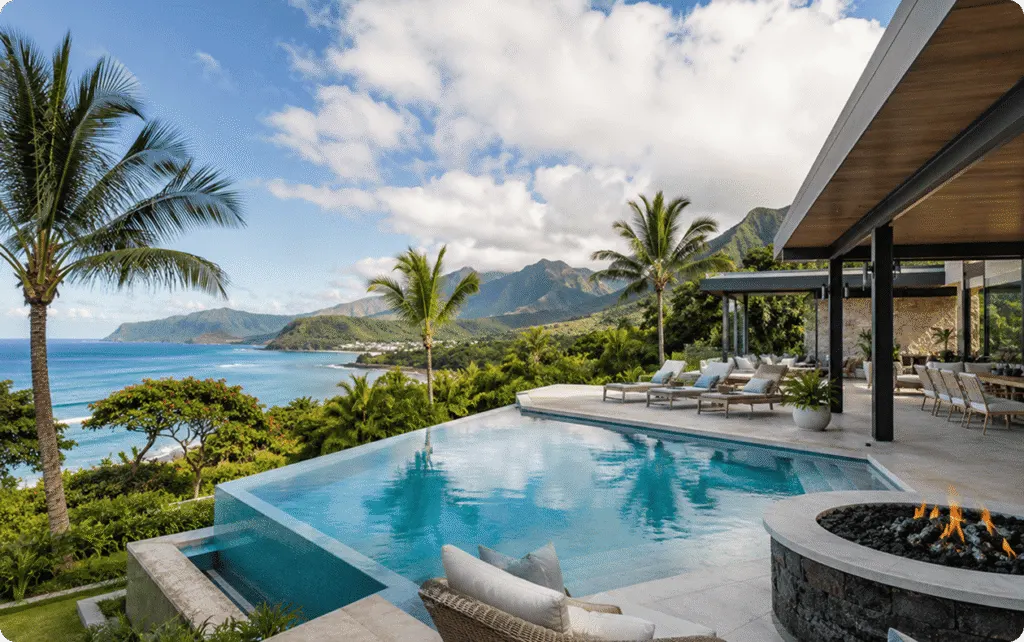



Mauritius is no longer just about postcard beaches and turquoise lagoons. Today, it stands as one of the most stable, secure, and dynamic jurisdictions in the Indian Ocean for structuring your wealth, establishing tax residency, or treating yourself to an exceptional tropical lifestyle.
However, unlike generalist portals or major international networks that simply list massive catalogs or skim over laws, our approach at DS Immobilier is built on a deep conviction: a successful real estate investment requires absolute transparency, precise geographic accuracy, and tailor-made human support.
Anchored at the heart of the northern region of Mauritius, our experts break down everything you need to know to successfully complete your property acquisition as a non-citizen in this comprehensive guide.
1. Why Invest in Mauritius? Key benefits
Moving to or investing in Mauritius means choosing a modern, internationally focused ecosystem that offers a rare quality of life:
- Political and institutional stability: Solid parliamentary democracy backed by a unique hybrid judicial system—combining the French Civil Code governing real estate property and contracts with British Common Law principles, with the Privy Council as the ultimate court of appeal—guaranteeing total legal security for land titles..
- Natural bilingualism: A population fluent in both French and English, greatly easing expatriate integration and business management.
- Top-tier infrastructure: Private clinics meeting European standards, renowned international schools, and smooth flight connectivity with Europe, Africa, and Asia.
2. The legal framework: Property acquisition schemes for non-Mauritian citizens
Unlike Mauritian citizens, a non-citizen cannot purchase just any real estate without prior approval from the Economic Development Board (EDB). The state has therefore established regulated frameworks to supervise foreign investments.
PDS (Property Development Scheme)
This is the flagship framework for purchasing luxury villas, duplexes, or high-end residences. It includes management services, concierge services, and leisure facilities (pools, clubs, fitness areas).
Smart City Scheme
These are sustainable urban ecosystems integrating residential zones, workspaces, shops, and universities. They allow the purchase of villas, apartments, or building plots within an ultra-modern setting.
The G+2 Scheme (Apartments)
This system allows foreigners to acquire apartments located in co-ownership buildings of at least R+2 (ground floor + 2 floors). It is an excellent alternative for a pied-à-terre or a targeted rental investment.
3. Comparative table of investment schemes
| Investment Scheme | Eligible Property Types | Minimum Investment Threshold | Key Advantage for the Buyer |
| PDS (Property Development Scheme) | Luxury villas, duplexes, penthouses | Varies by program | Permanent residency included (if investment ≥ 375,000 USD) |
| Smart City Scheme | Apartments, villas, building plots | Varies by developer | Integrated, eco-friendly, and innovative urban living environment |
| G+2 (Apartments) | Co-ownership apartments (min. R+2) | No minimum threshold required | Allows property purchase without a floor limit (residency if ≥ 375,000 USD) |
4. Residency permits and taxation: Core advantages
A major driver of real estate investment in Mauritius lies in tax optimization and obtaining resident status:
- Permanent Residency Permit: Any property purchase valued at a minimum of 375,000 USD within an eligible program (PDS, Smart City) grants a permanent residency permit to the owner, valid as long as they retain the property. It extends to the spouse and dependent children.
- A very mild tax system:
- No wealth tax (IFI).
- No inheritance tax in direct line of succession.
- A single tax rate capped at 15% on income and corporate profits.
- No exchange controls on the repatriation of funds or dividends.
5. Budgeting: Hidden costs and ancillary fees
Buying from afar or without deep local knowledge can lead to budgeting errors. At DS Immobilier, transparency is our signature. Make sure to account for all additional fees:
| Expense Item | Estimate / Indicative Rate | Description & Details |
| Registration Duty | Generally 5% of the price | Government tax levied upon the transfer of property (varies by scheme). |
| Notary Fees | Around 0.5% to 1.5% | Regressive scale calculated on the total value of the property. |
| EDB Application Fees | Fixed (per official scale) | Administrative fees for processing the residency permit. |
| Management Fees (Syndic) | Varies by residence | Essential for maintaining common areas, security, and collective facilities. |
6. Spotlight on the Northern Region: Strategic location choice
While the country offers superb regions, the North (from Grand Baie to Goodlands via Pereybere and Cap Malheureux) concentrates the highest rental and patrimonial appeal.
- High rental demand: Constant demand from expatriates and tourists, ensuring sustainable rental yields.
- Proximity to amenities: International schools, shopping malls, modern clinics, and direct access to the island’s finest lagoons.
7. The DS Immobilier advantage: A women-led, field-driven approach
Facing impersonal real estate portals, DS Immobilier relies on an agile, ultra-qualitative “women-led” approach.
- Surgical prospecting: We don’t try to drown you in a catalog of thousands of properties, but rather to identify the property that precisely matches your lifestyle or investment return objectives.
- Global support (Relocation & concierge): From opening your local bank account to securing your residency permit with the EDB, through to post-acquisition rental management, our team saves you from dealing with multiple intermediaries.
8. Frequently Asked Questions (FAQ)
Can a foreigner buy any land or house in Mauritius?
No. Outside of approved schemes (PDS, Smart City, G+2), the acquisition of “standard” real estate (land or houses outside integrated residences) is strictly reserved for Mauritian citizens.
What is the minimum investment required to obtain a permanent residency permit?
To obtain a permanent residency permit linked to real estate, the acquisition amount in an eligible program (such as PDS or certain Smart Cities) must be at least 375,000 USD. This permit remains valid as long as you own the property.
Can I rent out my property for short-term rentals (such as Airbnb)?
Yes, but under conditions. Villas located within PDS developments generally feature an integrated rental management service that allows tourist rentals. For G+2 apartments, you must check the co-ownership bylaws and specific regulations in force.
What are the tax advantages for a foreign investor in Mauritius?
Mauritius does not levy wealth tax (IFI) or direct line inheritance tax. Furthermore, rental income and capital gains benefit from a single 15% tax rate, without heavy additional social security contributions.
In Summary: Your project starts here
Want to finalize a real estate purchase in Mauritius with complete peace of mind? Let our team of experts based analyze your criteria and open the doors to exclusive properties.
Contact DS Immobilier today or submit your custom property search to start your project under the best possible conditions.